Thoughts on the traditional deck
The traditional deck has 13 different cards (been this way since the 1500’s) which is too many different cards, from Ace, 2, 3 and up to King, for a host of rules options. With no repeat cards (what is wrong with repeat cards?) and 4 suit choices, there is again certain ways the deck cannot be used. I am a teacher and I assure you that most students do not know all of the card types and quantities in a tradition deck. Clearly, they never played a game called “52 Card Pick Up”! Since I teach math, I also have had to experience teaching probabilities using the traditional deck which many of my students had never seen or used for a game. And yet, look at how many really good card games people play using a traditional deck.
Again, there are limitations to the traditional when it comes to game play. Once you see a particular card you either know it is gone or know exactly where it is, because there is only 1 of each card. You cannot add card values in the deck. When card values are compared, the Ace commonly beats all others and you hardly care about the rest. If someone makes or matches a set a card in your hand can become worthless. We do not tend to play multiple cards in a trick or turn, unless laying down sets. There cannot be a mystery card because your chance is 1 in 52, or unless you have a magician playing.
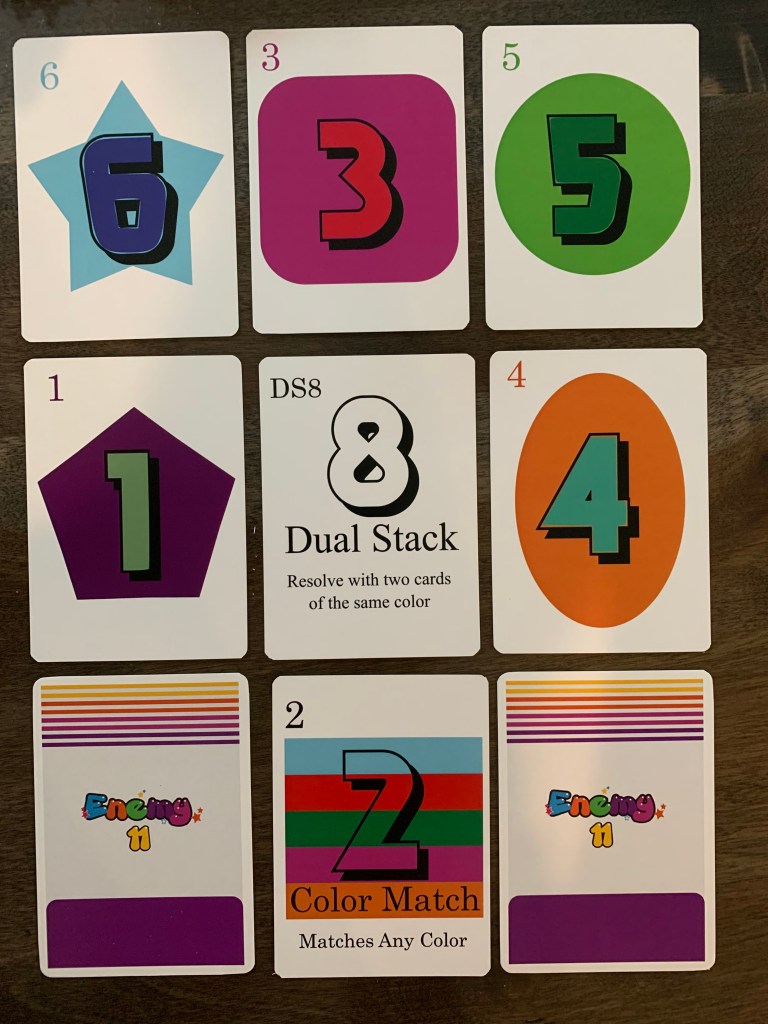
Only a week after designing Enemy 11, my brain hashed through all of these comparisons of decks until I arrived at a conclusion. My Enemy 11 concept is the beginning of creative game design using a base deck (the DDD Deck – pronounced Triple D Deck) of cards to take card games into new areas where the traditional deck could not go. It could inspire a very large branch of games yet to be designed through the concept of using this base deck (the DDD Deck). Though I have played nearly all card games except Peaknuckle (which I spelled the way I say it and had to look up the spelling to be Pinochle), my passion was always board games and then historical miniatures. But card games are the easiest thing to store and pull out to play with friends and family around a table. They provide a highly social setting with given stoppages in play while shuffling and dealing the cards for the next round of play. It is certainly a type of game play which has captured many evenings, promoting some thinking, while playing games for fun.
Question
The DDD Deck is a simple workable idea for a new deck. I am finding that I need to add cards to play different games. Is this a good thing or a bad thing? Does this mean that all games using this base deck need to be produced separately? Not sure I can visualize grabbing a single DDD Deck and asking “what game shall we play?” Will having to grab special cards deter people from keeping this deck readily available?
 Doc Dave DeWitt